

Artificial intelligence (AI) tools are becoming an important part of our daily lives. From writing blog posts and creating images to researching topics and planning marketing campaigns, AI can help us complete many tasks faster.
However, the results you receive from an AI tool depend partly on how you communicate with it. A vague instruction may produce a general answer, while a clear and detailed instruction can produce a more useful result.
This is where prompt engineering comes in.
In this beginner-friendly guide, you will learn what prompt engineering is, how it works, why it matters, and how to write better AI prompts with practical examples.
What Is Prompt Engineering?
These instructions are called prompts. A prompt can be a question, a command, a description, or a set of requirements.
For example, you could ask an AI tool:
Basic prompt: Write a blog about digital marketing.
Improved prompt: Write a beginner-friendly, 1,000-word blog about digital marketing trends for small businesses. Use simple English, clear headings, practical examples, and an FAQ section.
The second prompt gives the AI more information about the topic, audience, length, and expected structure.
As a result, the output is more likely to match your requirements.
Prompt engineering does not always require technical or coding skills. Beginners can learn it by practising clear instructions and improving them based on the results.
How Does Prompt Engineering Work?
Prompt engineering helps you communicate your requirements to an AI model. The model uses the information in your prompt and its learned patterns to generate a response.
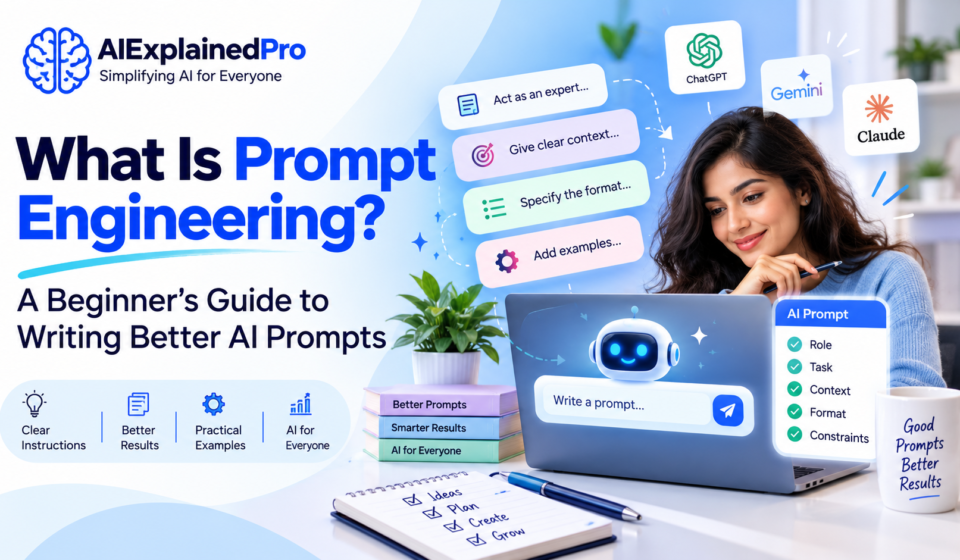
A useful prompt often includes these elements:
1. Role
Tell the AI what kind of expertise or perspective you want it to use.
Example: “Act as an experienced SEO content writer.”
2. Task
Clearly explain what you want the AI to do.
Example: “Write an SEO-friendly blog introduction about artificial intelligence.”
3. Context
Provide background information that helps the AI understand your requirements.
Example: “The article is for beginners who have never used AI tools before.”
4. Format
Specify how you want the answer presented.
Example: “Use short paragraphs, H2 headings, bullet points, and five FAQs.”
5. Constraints
Mention any important limits or requirements.
Example: “Use simple English, avoid unnecessary technical terms, and keep the introduction under 150 words.”
Combining these elements can make your instructions easier to understand and your results more consistent.
Why Is Prompt Engineering Important?
Prompt engineering is useful because AI tools do not automatically know every detail of what you want.
A well-written prompt can help you:
1. Get more relevant answers.
2. Save time when creating content.
3. Generate better ideas and outlines.
4. Improve the structure of blog posts and reports.
5. Create more targeted marketing content.
6. Reduce unnecessary revisions.
7. Use AI tools more effectively for everyday tasks.
However, a better prompt does not guarantee a perfect answer. AI-generated information can still contain errors, so important facts should be checked before publication or use.
7 Practical Prompt Engineering Techniques for Beginners
You can start using these techniques without any programming knowledge.
1. Be Specific
Avoid vague instructions. Explain exactly what you need.
Weak prompt:
“Write about SEO.”
Better prompt:
“Write a beginner-friendly guide explaining on-page SEO, including title tags, meta descriptions, headings, internal links, and image alt text. Include one practical example for each.”
Specific prompts reduce ambiguity and help the AI focus on your actual requirements.
2. Provide Context
Give the AI enough background to understand your audience and purpose.
For example:
“I run a beginner-friendly AI blog. Write an article explaining how AI tools can help small business owners save time. Assume the readers have limited technical knowledge.”
This context helps guide the language, examples, and level of detail.
3. Define the Output Format
Tell the AI how you want the response organised.
You can request a table, checklist, step-by-step guide, email, social media caption, or blog outline.
For example:
“Compare five AI writing tools in a table with columns for tool name, main features, best use case, limitations, and pricing page.”
If you need structured information, specifying the format can make the output easier to use.
4. Give Examples
Examples help demonstrate the tone, style, or structure you want.
For example:
“Write three Instagram captions in the style of this sample: ‘Simple ideas. Smarter work. Better results.’ Keep each caption short, friendly, and suitable for a professional audience.”
Use examples as guidance rather than expecting the AI to reproduce every detail exactly.
5. Break Complex Tasks Into Smaller Steps
Instead of asking for a complete marketing strategy in one instruction, divide the work into smaller tasks.
For example:
1. Identify the target audience.
2. Suggest relevant content topics.
3. Create a one-month content calendar.
4. Write captions for selected posts.
5. Suggest suitable performance metrics.
This approach makes it easier to review each stage and correct mistakes before moving forward.
6. Ask the AI to Improve Its Previous Answer
Your first result does not need to be the final result.
You can follow up with instructions such as:
“Make the introduction more engaging.”
“Use shorter sentences.”
“Add practical examples.”
“Remove repetitive information.”
“Explain this concept in simpler English.”
This process is called iterative prompting: you refine the instructions based on the response you receive.
7. Include Clear Success Criteria
Tell the AI what a good result should achieve.
For example:
“Create five blog title ideas. Each title should be easy to understand, relevant to beginners, and suitable for an educational AI website. Avoid exaggerated claims and misleading promises.”
Clear criteria help the AI focus on the qualities that matter most to you.
Prompt Engineering Examples for Everyday Tasks
Here are some practical examples you can adapt for your own work.
Example 1: Blog Writing
Prompt:
“Act as an experienced content writer. Write a beginner-friendly article about the benefits of generative AI. Use simple English, informative H2 headings, real-world examples, a conclusion, and five FAQs. Avoid unsupported statistics and explain technical terms clearly.
”Example 2: SEO Keyword Research
Prompt:
“Act as an SEO specialist. Suggest 20 relevant keyword ideas for a beginner-friendly website about artificial intelligence. Group them by search intent and topic. Include informational and practical tutorial ideas. Do not invent search volume or keyword difficulty figures.”
Always verify keyword metrics using an SEO research tool before using them in a strategy.
Example 3: Social Media Marketing
Prompt:
“Act as a social media content strategist. Create five Instagram captions for a fashion brand promoting an embroidered co-ord set. Use a friendly, modern tone, include a clear call to action, and suggest relevant hashtags. Do not invent product features or discounts.”
Example 4: Email Writing
Prompt:
“Write a professional follow-up email to a client who has not responded to my previous proposal. Keep it polite, concise, and friendly. Include a suitable subject line and a simple call to action.”
Example 5: Learning a New Topic
Prompt:
“Explain machine learning to a complete beginner. Use a simple real-world example, explain three important terms, and finish with five short quiz questions and their answers.”You can change the topic, audience, tone, or format to suit your needs.
What Are the Best AI Tools for Prompt Engineering?
Several AI tools can help you practise prompt writing. Their capabilities, pricing, and available features may change over time.
ChatGPT: Useful for writing, brainstorming, explaining concepts, and refining instructions. Visit ChatGPT.
Google Gemini: Useful for research assistance, idea generation, writing, and other supported AI tasks. Visit Google Gemini.
Claude: Useful for writing, analysis, summarisation, and working with longer instructions or documents. Visit Claude.
Microsoft Copilot: Useful for supported AI assistance across writing, research, and productivity workflows. Visit Microsoft Copilot.
You do not need to learn every tool at once. Start with one tool, practise writing clear prompts, and compare the results.
For more background, read the official documentation on OpenAI prompt engineering.
Common Prompt Engineering Mistakes to Avoid
Even a useful AI tool can produce disappointing results when instructions are unclear.Avoid these common mistakes:
> Being too vague: Explain the task and expected outcome.
> Providing too little context: Mention the audience, purpose, and background.
> Combining unrelated tasks: Break complicated requests into manageable steps.
> Ignoring output requirements: Specify length, tone, format, and structure when needed.
> Accepting every answer without checking: Verify facts, statistics, quotations, and important claims.
> Sharing sensitive information: Avoid including passwords, confidential client information, or private personal data in prompts.
> Expecting one prompt to work perfectly every time: Review the output and refine your instructions.
Remember that prompt engineering is a practical skill. You will improve as you experiment, evaluate the results, and learn which instructions work best for your tasks.
Is Prompt Engineering a Technical Skill?
Prompt engineering can be used by people with or without a technical background.
For everyday tasks such as content writing, research, learning, and social media marketing, you can start with ordinary language. You do not need to know a programming language.
More advanced applications may involve structured outputs, APIs, automated workflows, or code. These applications can require additional technical knowledge.
For beginners, the best starting point is to learn how to describe a task clearly, provide relevant context, and review the result critically.
What Is the Future of Prompt Engineering?
Prompt engineering will continue to evolve as AI systems become more capable and easier to use.
Some tools may require fewer detailed instructions as their interfaces improve. At the same time, the ability to define goals, provide relevant context, evaluate outputs, and guide AI systems through complex tasks will remain valuable.
For digital marketers, content creators, students, and business owners, these skills can support more effective use of AI tools.
The goal is not to memorise a collection of magic words. It is to communicate clearly, understand the task, and judge whether the output meets your requirements.
Final Thoughts
Prompt engineering is an important practical skill for anyone who wants to use artificial intelligence more effectively.
By writing specific instructions, providing context, choosing the right output format, and refining your prompts, you can often get more useful results from AI tools.
Start with simple tasks, test different approaches, and check the accuracy of the answers. With practice, you can build a collection of prompts that supports your writing, research, learning, and marketing work.
Ready to explore more AI? Start with our guide to what generative AI is and how it works, then practise these techniques with your favourite AI tool.
Frequently Asked Questions (FAQs)
1. What is prompt engineering in simple words?
Prompt engineering means writing clear instructions for an AI tool so it can generate a response that better matches your needs.
2. Is prompt engineering easy to learn?
Yes. Beginners can start by writing specific instructions, adding context, choosing a response format, and improving their prompts based on the results.
3. Do I need coding skills for prompt engineering?
No. Basic prompt engineering for writing, research, learning, and marketing can be done using ordinary language. Some advanced AI applications may require technical skills.
4. What is an example of a good AI prompt?
“Explain artificial intelligence to a beginner in 300 words. Use simple English, three real-world examples, clear headings, and a short summary.”This prompt specifies the topic, audience, length, language, and format.
5. Which AI tool is best for prompt engineering?
There is no single best tool for every task. ChatGPT, Google Gemini, Claude, and Microsoft Copilot are options to explore. Choose one based on your needs, available features, and budget.
6. Can prompt engineering help with SEO?
Yes. It can help generate content outlines, keyword research ideas, title suggestions, meta descriptions, and content briefs. However, keyword metrics and SEO recommendations should be verified using reliable tools and actual search data.
7. Will prompt engineering remain useful in the future?
Its methods may change as AI tools improve, but the ability to define goals, provide context, assess AI-generated information, and guide AI toward useful outcomes is likely to remain valuable.